



Quality Management System
The University of Graz’s quality management system encompasses all of the University’s quality-related activities and is geared towards creating an environment that promotes quality and achieving the strategic objectives.
Quality Circle
The quality management system is integrated into the university’s strategic management and follows a continuous quality cycle.
University of Graz quality cycle:
1. Situation analysis: to provide a holistic assessment, strengths and weaknesses are analysed and opportunities and risks are assessed. For example, through SWOT analysis, portfolio analysis and research evaluation.
2. Formulating objectives: quality and quality standards are defined in the form of measurable targets, and procedures for assessing the achievement of these targets are agreed. E.g. in the mission statement, strategic objectives and development plan
3. Planning and implementation: Measures are developed and implemented in line with the set objectives. For example, budgeting, establishing research priorities, and target and performance agreements with the faculties.
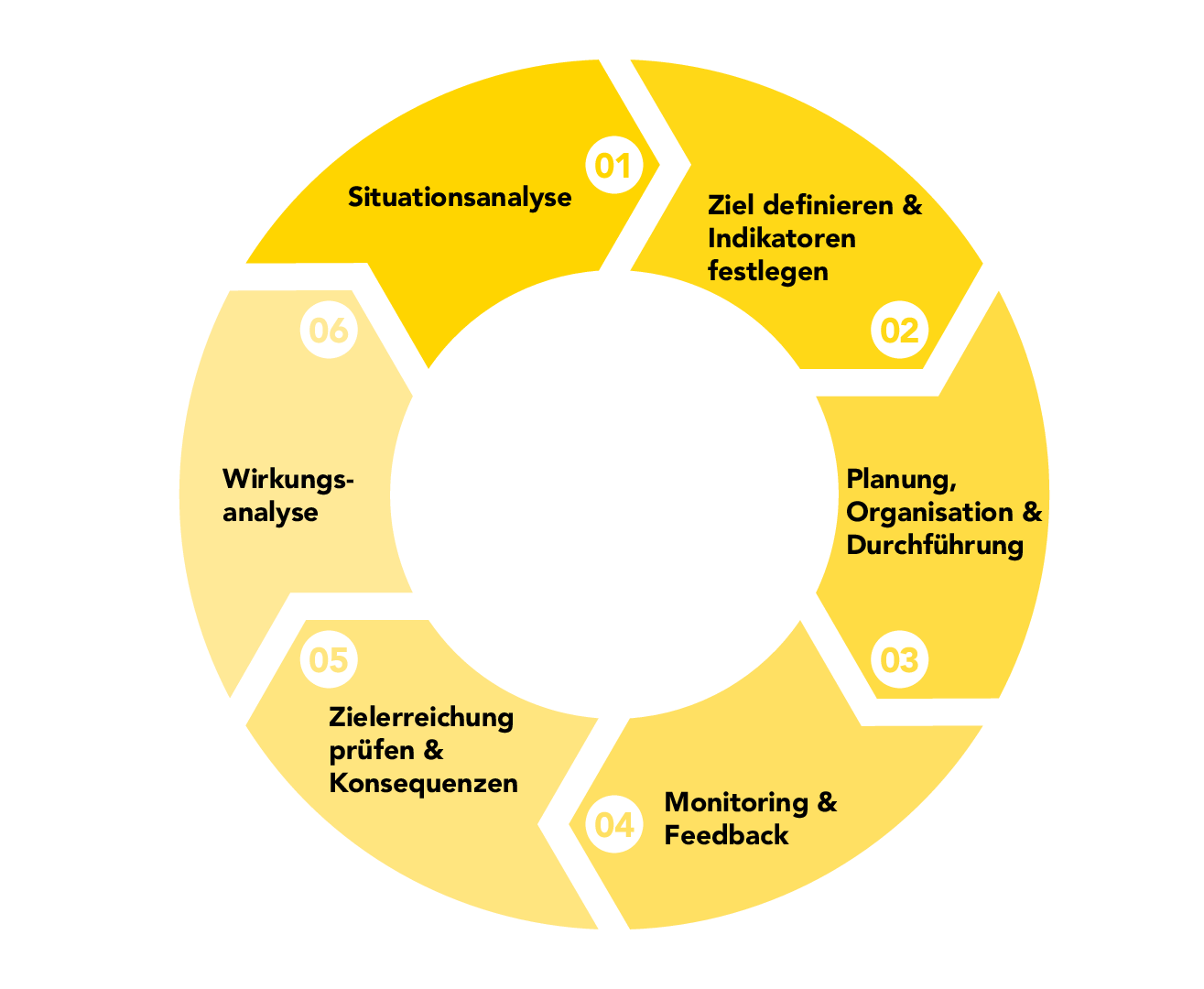
4. Monitoring with feedback: the ongoing observation of a measure or process, allowing for corrective action to be taken should it not proceed as intended or should certain thresholds be breached or exceeded. This creates a kind of ‘early warning system’ that helps identify undesirable developments, thereby enabling adjustments to be made in good time. This can be achieved through, for example, reporting systems, annual staff appraisals and monitoring meetings
5. Reviewing target achievement and consequences: Measuring and reviewing the achievement of targets, as well as investigating the causes of deviations from targets. The analysis of target achievement is linked to a discussion and the derivation and implementation of improvement measures. For example, as part of the intellectual capital statement, the conclusion of target and performance agreements with penalties, and research evaluation
6. Impact analysis: the effects of a measure and its side effects are identified and serve as the basis for further development steps. Through the quality management (QM) system, not only performance but also impacts are systematically assessed, following which measures are decided upon to bring about the desired improvements. E.g. through graduate and labour market analyses, and the reputation of researchers
Quality in research
Quality management also aims to create favourable conditions for outstanding research. Research evaluation serves to ensure quality and performance in both a national and international context, and to ensure that research activities are aligned with strategic planning. Given the significant influence staff have on quality, measures to promote research are of central importance.

Research evaluation
Research evaluation forms part of the University’s quality management system and is a self-governance tool designed to support planning and decision-making processes. It serves the purposes of self-assessment in a national and international context, quality development and performance improvement. It is therefore intended to provide a basis for setting future priorities, to act as an incentive for developing academic profiles and for the self-assessment of subjects and disciplines, and to spur on academic development.
The evaluation procedure comprises self-assessment by the units being evaluated, as well as, where necessary and by agreement, a peer review process carried out by external experts. Institutes undergo an external evaluation every seven years and centres every five years. Newly established institutes or centres are evaluated no later than five years after their establishment.
Details of the procedure can be found on the intranet

Quality in teaching
Quality assurance is one of the autonomous responsibilities of a university and is a top priority at the University of Graz. In this way, the university fulfils its responsibility towards its students, who expect education and training that reflect the latest scientific developments and offer them a strong start to their professional careers. Students also expect to be able to complete their studies within a reasonable timeframe. In this context, quality assurance and quality development in teaching involve reviewing and improving not only the content-related educational standards but also the organisation of teaching and study programmes. Both students and teaching staff must be equally involved in this process.
The Teaching and Student Services Department utilises a range of quality assurance tools in the field of teaching.
Quality Audit
In 2020/2021, the University of Graz underwent the statutory certification of its quality management system for the second time. The FINEEC Accreditation Commission successfully approved the recertification, with no conditions attached, for the next seven years until August 2028.